Dynamics 365 Finance and Operations Data: Understanding and Solving the Analytics Pipeline
From First Mile Extraction to Last Mile Usability
Introduction: The Analytics Expectation vs. Reality
Microsoft Dynamics 365 Finance and Operations (F&O) has become the operational backbone for modern enterprises. Finance, supply chain, procurement, inventory, and manufacturing systems all generate high-volume transactional data within F&O. As organizations mature in their analytics journey, this data becomes strategically critical.
Microsoft’s architectural choice was deliberate: optimize F&O for transactional throughput and offload analytics to purpose-built cloud services such as Azure Data Lake, Azure Synapse Analytics, and now Microsoft Fabric. From a scalability and performance standpoint, this separation is sound.
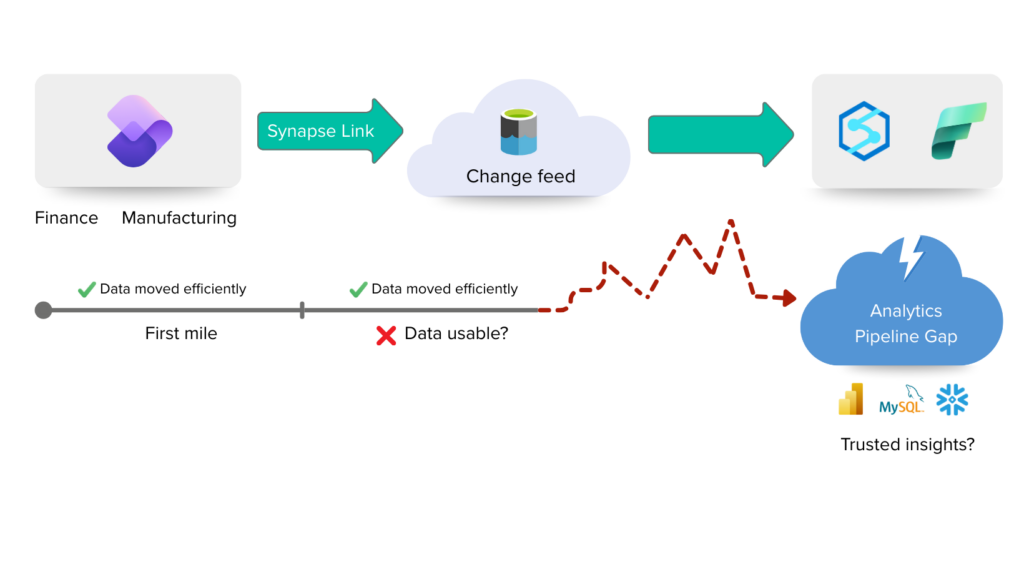
However, while this architecture successfully moves data out of F&O, it does not automatically make that data usable. This disconnect manifests as what many organizations now experience as an analytics pipeline gap—best understood by separating the problem into first-mile and last-mile concerns.
Part 1: The First Mile—Extracting Data from D365 F&O
The Early First-Mile Approach: BYOD and Custom Pipelines
Before cloud-native extraction mechanisms were available, organizations relied heavily on Bring Your Own Database (BYOD) or custom export pipelines to move data out of F&O.
While functional, these approaches introduced significant trade-offs:
- Production load: BYOD queried live transactional tables, competing with business workloads.
- High latency: Batch-based exports resulted in stale data.
- Schema fragility: Frequent F&O updates and extensions routinely broke downstream logic.
- Scaling challenges: SQL staging environments required constant tuning.
For many enterprises, first-mile extraction became an operational burden rather than an enabler.
Synapse Link: Solving the First Mile
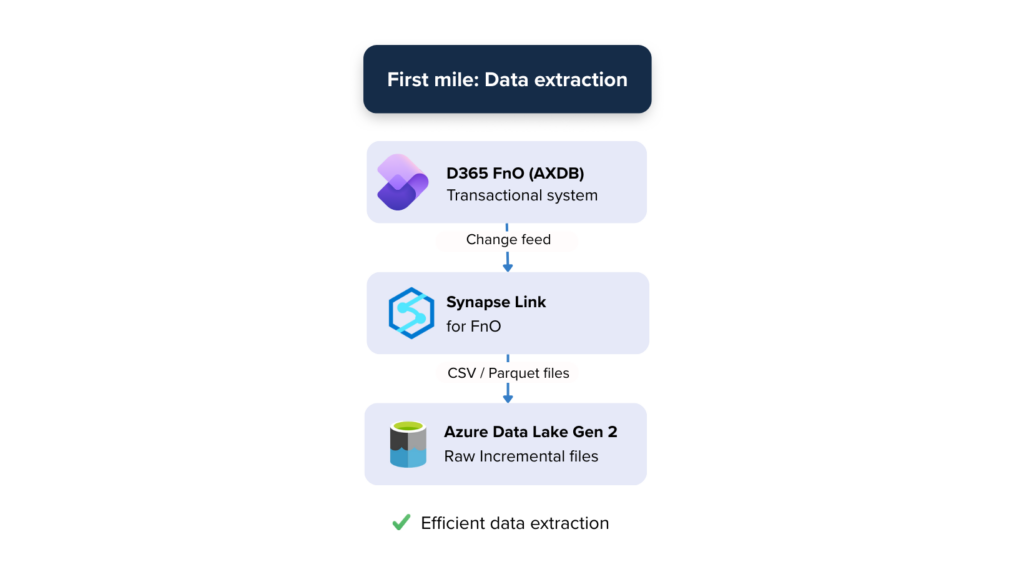
Synapse Link for Dynamics 365 F&O marked a fundamental shift in first-mile data movement.
By streaming entity-level changes into Azure Data Lake Storage Gen2 using a change-feed mechanism, Synapse Link delivered:
- Near real-time data extraction
- Cloud-native scalability
- Minimal impact on transactional workloads
- A clean separation between OLTP and analytics systems
From a data movement perspective, Synapse Link decisively solved the first-mile problem. Data was now leaving F&O efficiently, continuously, and safely.
Part 2: The Last Mile—Making Data Analytics-Ready
Why First Mile Success Exposes the Last Mile Problem
While Synapse Link excels at extracting data, it stops at delivery. The output—append-only CSV or Parquet files representing incremental changes—reflects what changed, not what currently exists.
This distinction is critical.
Analytics platforms such as Power BI, Fabric Warehouse, Azure SQL, or Snowflake expect:
- Deterministic schemas
- Relational tables
- Primary keys
- Consistent current-state data
Change feeds alone do not meet these requirements.
Understanding the Last Mile
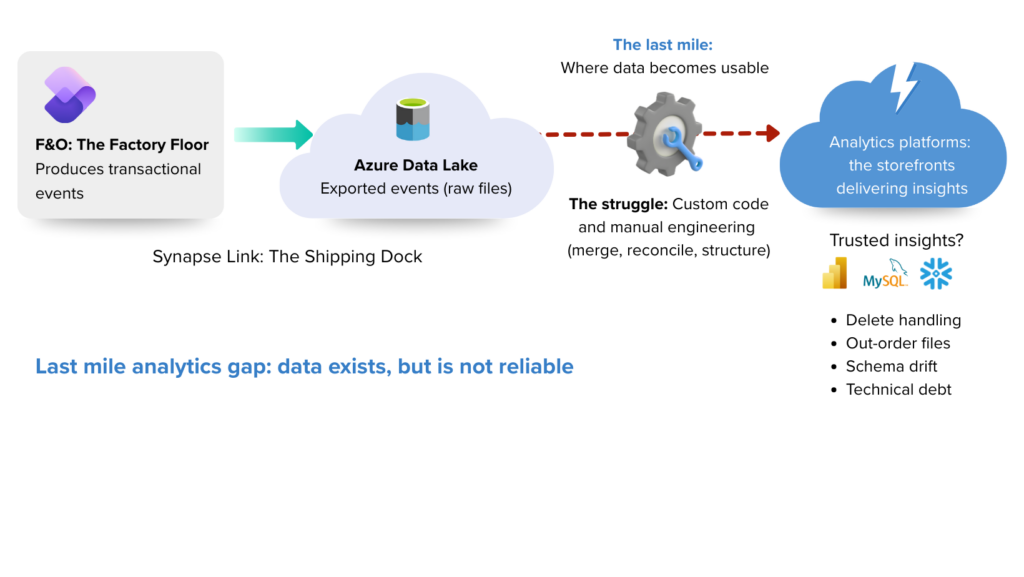
The analytics pipeline can be viewed as a supply chain:
- F&O is the factory floor producing transactional events
- Synapse Link is the shipping dock exporting those events
- Analytics platforms are the storefronts delivering insights
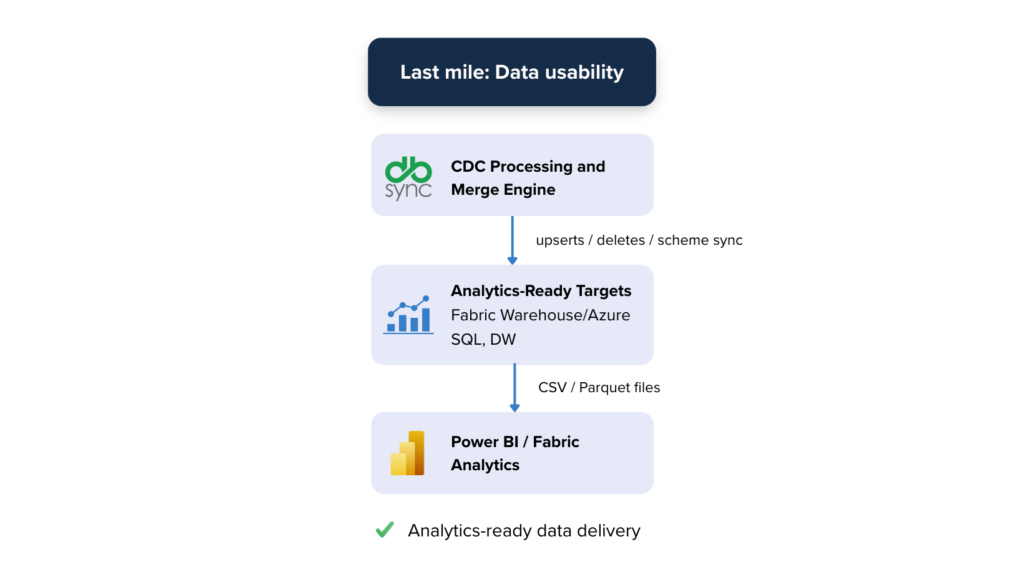
Between export and insight lies the last mile—where raw change data must be merged, reconciled, and structured into usable tables.
This is where most organizations struggle.
The Cost of DIY Last-Mile Engineering
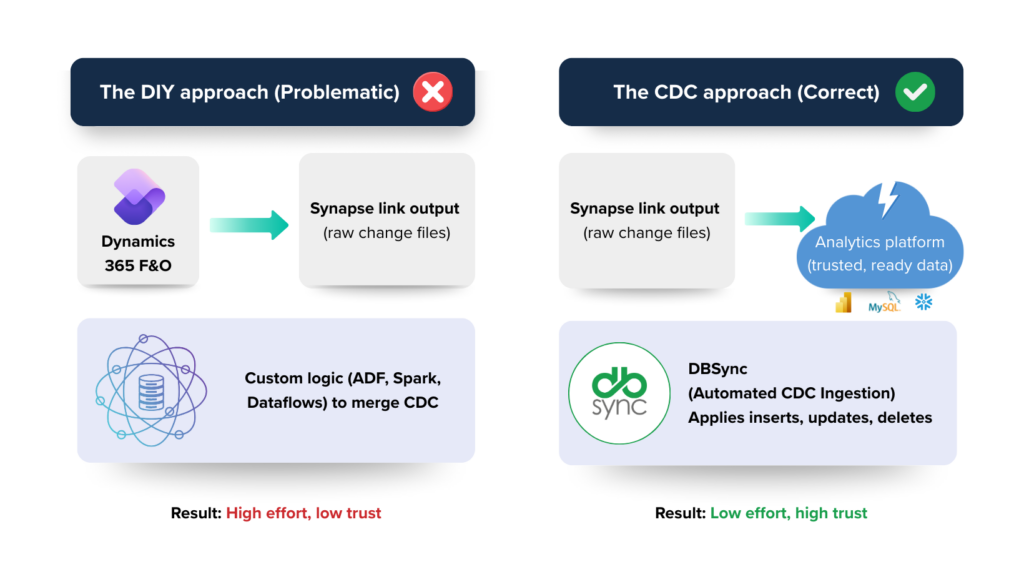
To bridge this gap, teams often build custom pipelines using Azure Data Factory, Fabric Dataflows, or Spark notebooks. What appears manageable initially quickly becomes complex:
- Delete handling requires careful interpretation of flags
- Out-of-order files demand timestamp reconciliation
- Historical tracking introduces additional logic
- Schema drift creates silent failures
Over time, these pipelines accumulate technical debt. More critically, they erode trust in analytics when dashboards fail or data becomes inconsistent.
Why Business Teams Feel the Pain First
When last-mile pipelines falter:
- Power BI dashboards become stale
- Financial and operational reports drift
- Decision-making slows
The data exists, but it is no longer reliable. This is the practical definition of the last-mile analytics gap.
Part 3: Completing the Last Mile
The Key Insight: Synapse Link Is a CDC Source
Independent analysts consistently characterize Synapse Link correctly—as a change-data-capture (CDC) source, not an analytics destination.
Its value lies in efficient extraction. The responsibility for materializing that data into analytics-ready structures remains downstream.
DBSync’s Role in the Architecture
DBSync is designed specifically to operationalize this last mile.
By treating Synapse Link output as a continuous CDC stream, DBSync:
- Automatically applies inserts, updates, and deletes
- Maintains analytics-ready relational tables
- Handles schema evolution without manual intervention
- Reads exclusively from Azure Data Lake, avoiding production impact
Instead of hand-coding merge logic or managing Spark infrastructure, teams rely on DBSync to continuously synchronize F&O data into their analytics platforms.
How DBSync Aligns with Microsoft’s Data Ecosystem
DBSync does not replace Microsoft components—it complements them:
- Synapse Link handles first-mile extraction
- Azure Data Lake stores raw change data
- DBSync performs last-mile transformation and synchronization
- Fabric / Power BI / Azure SQL deliver analytics and insights
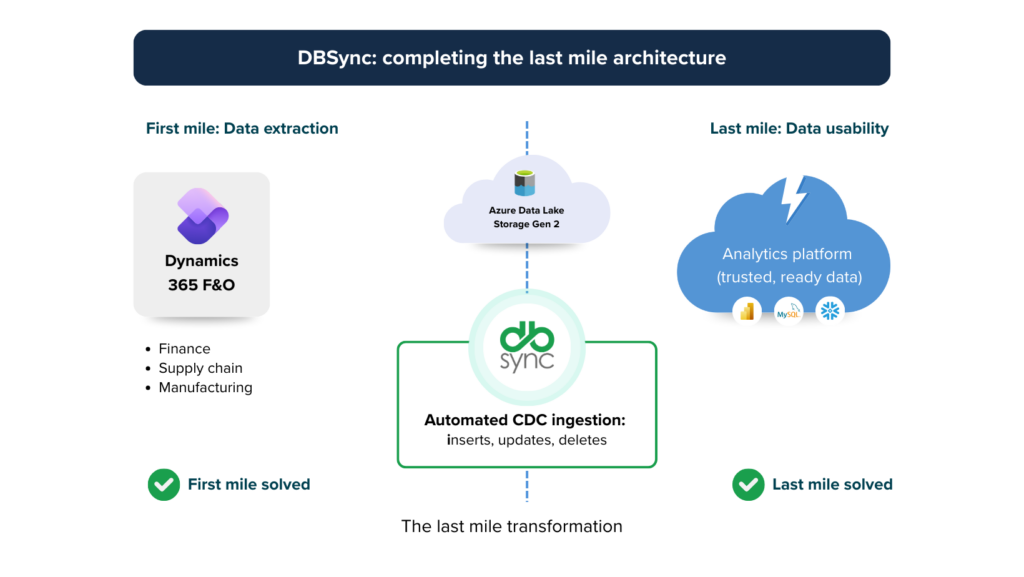
This architecture preserves Microsoft’s intended separation of concerns while eliminating operational friction.
Business Outcomes of Closing the Last Mile
Completing the last mile delivers tangible benefits:
- Consistent, trusted analytics
- Reduced engineering overhead
- Faster time-to-insight
- Safe retirement of legacy BYOD pipelines
- Future-proofing as Microsoft transitions from Synapse to Fabric
Conclusion: From Data Movement to Data Usability
Microsoft’s ecosystem provides a robust foundation for F&O analytics, but extraction alone is not enough. The real challenge lies in transforming continuous change data into a reliable, queryable state.
Viewing the architecture through the lens of first mile vs. last mile clarifies the gap:
- Synapse Link starts the journey
- DBSync completes it
In modern analytics architecture, success is no longer about moving data—it’s about making data continuously usable.